



· Trevor Nicks, PhD
Pragmatic Inventions
Caravel: The Data Engine for the Biomolecular Frontier
For millennia, humans have worked to see more by creating and manipulating light: fire, candles, whale oil lamps, light bulbs, LEDs. We want so desperately to see, to know and observe the world.
The first electric light flickered in a British laboratory in 1802. That first arc lamp was too short-lived, inefficient, and expensive to be more than a curiosity, but it lit a spark in generations of inventors. Nearly eighty years later, Thomas Edison and his team tested more than 6,000 designs before producing a commercially viable incandescent bulb. Edison’s team didn’t discover electric light. They made it pragmatic: cheap, reliable, and accessible through manufacturing. The descendants of that first arc lamp and those incandescent bulbs are the lights of Times Square, the lasers in our scientific instruments, and the screen you’re reading this on.
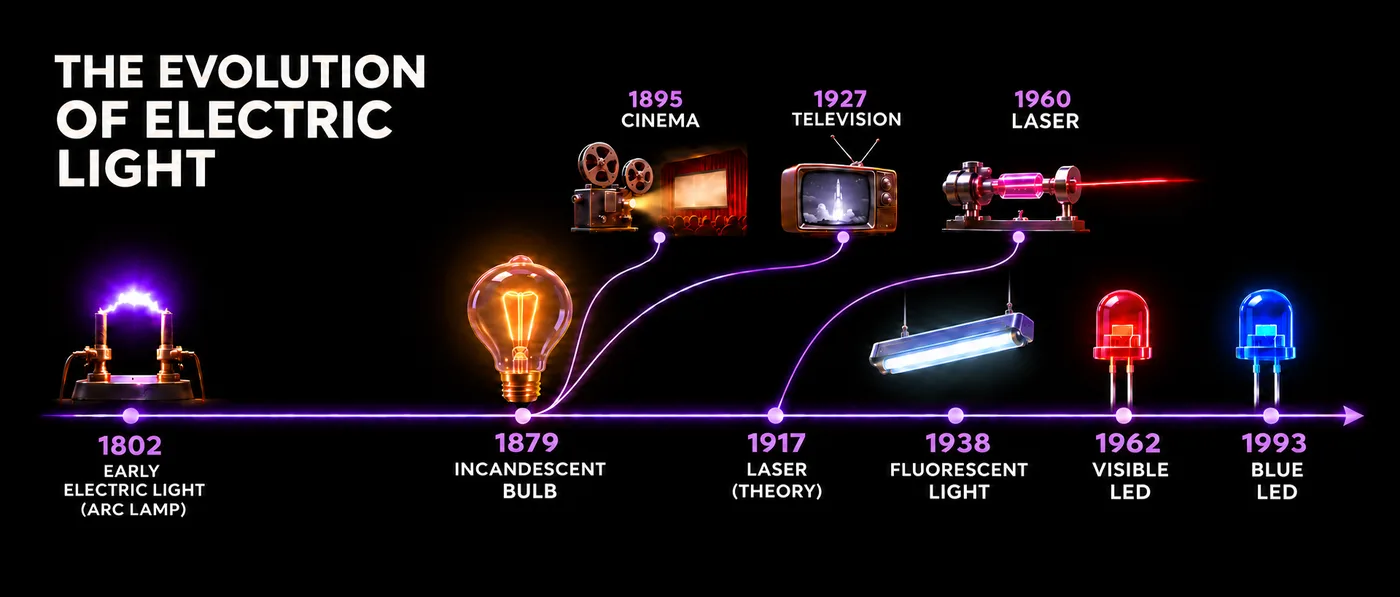
Yet, some historians argue that Edison’s greatest invention wasn’t the light bulb but the process behind it [Israel, 2006]. His lab systematized invention: experiment, collect data, grow understanding, then engineer products from that knowledge. The Edison Lab in Menlo Park, NJ became a factory for contract invention, a place where business and imagination collided. Edison’s team produced breakthroughs in electricity, sound recording, motion pictures, telecommunications, mining, chemicals and even cement. That data engine became the foundation of General Electric, one of the most valuable companies of the 20th century.
Biology has not had its Menlo Park moment, because biology happens in the dark. Many of the molecules biotechnology engineers work with, like proteins, DNA and the machinery of cells, are smaller than a wavelength of visible light. No ordinary microscope can show them to us. The most advanced instruments can take months to capture a single structure, and even then a picture rarely reveals what a molecule does. Understanding function requires many kinds of measurement, so invention in biology is tedious, slow and expensive.
Even so, biotechnology has delivered remarkably useful, pragmatic inventions. It has given us recombinant insulin, more targeted cancer therapies, stain-fighting enzymes in laundry detergent, and GLP-1 drugs like Ozempic. But bringing a single new product to market routinely costs more than $2B [DiMasi, 2016]. The process works. It just works slowly.
For every bio-product available today, many more sit where the arc lamp sat in 1802: glimpsed, promising, not yet practical. These include systems for non-toxic chemical manufacturing, novel cures, and preventive medicines that extend healthy life. Inventors will keep chasing these ideas, but with today’s methods, it may take decades to make them real.
Our mission at Caravel: accelerate the process of turning dreams into pragmatic inventions
What if biology got a new process of invention? How much faster and cheaper could we move from idea to product? How much closer could we bring the future? These questions sit at the heart of Caravel. The arc lamp waited nearly eighty years to become the light bulb. We do not want to wait that long for the materials, cures, and medicines of tomorrow.
We want to get to the equivalent of the 6,000th light bulb for these dreams faster. For us, that means making it easier to see and design biomolecular function. So, we have built a new process of invention that illuminates more of the biomolecular world and turns what we see into things we can make. We first built new systems for engineering enzymes. Those methods led to novel capabilities for other proteins and biomolecules too. We are creating the data engine for the biomolecular frontier: a factory for invention where we will design a better future. In the coming months and years, we will be sharing more about how we are creating new forms of data collection and invention — accelerating discovery, lowering the cost of prototyping, and generating holistic data sets that enable pragmatic inventions.
The screen you are reading this on began as a dream that led to a brief glow in a British laboratory in 1802. We and our customers have dreams of biomolecules that will be just as important to society as light bulbs. We are here to turn those dreams into pragmatic inventions.
More coming soon…
At Caravel, our mission is to make biology move as fast as human imagination. We are simultaneously miniaturizing, parallelizing, and expanding experimentation so scientists can test more ideas, discover faster, and create products that improve life on Earth. We will be sharing more about what we are building here.


Your dream protein is out there
